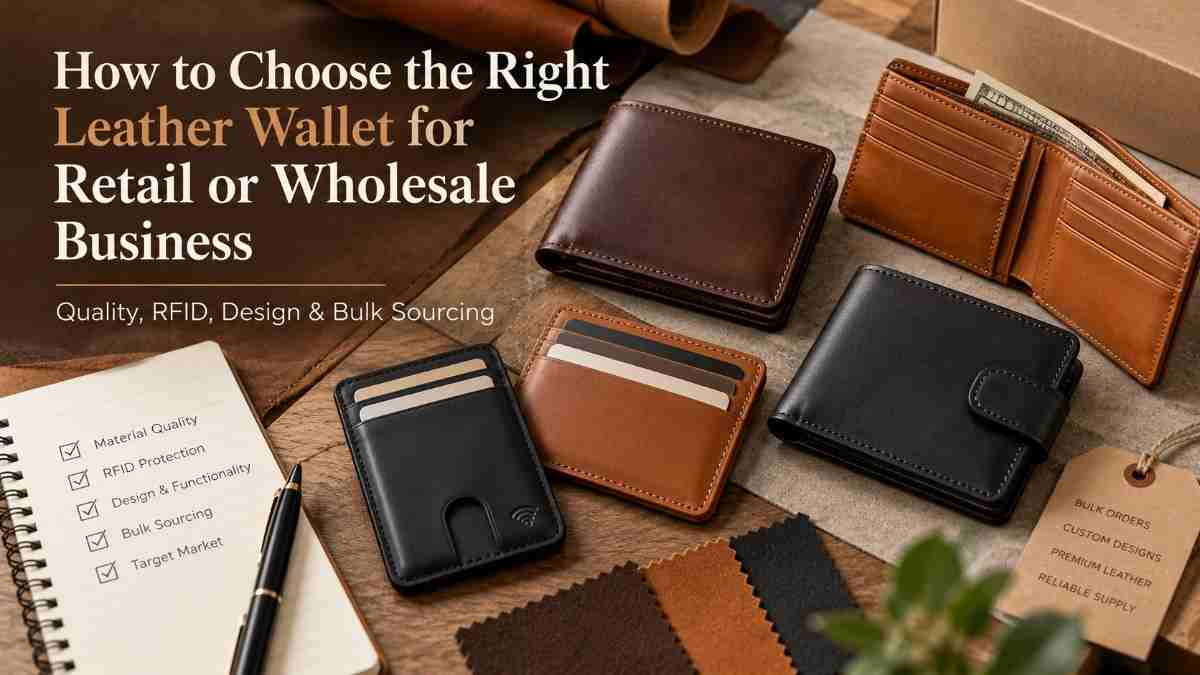
Choosing the right leather wallet for a retail or wholesale business involves more than selecting a design that looks attractive. Buyers need to consider leather quality, stitching, storage capacity, durability, finishing, target customer preferences, branding options, and order quantities.
A wallet that performs well in a retail store should offer a balance of appearance, everyday usability, and consistent manufacturing quality. For wholesalers and distributors, repeatability across large quantities is equally important.
Businesses sourcing from a professional leather products manufacturer should therefore evaluate both the product and the manufacturer's production capabilities before placing a bulk order.
What Should Retailers Look for When Choosing Leather Wallets?
Retailers should start by understanding who will actually buy the wallets.
Different customers may prefer different combinations of size, design, card capacity, leather finish, and price point.
Important factors to evaluate include:
- Leather quality
- Wallet dimensions
- Number of card slots
- Cash compartments
- Coin pockets where required
- Stitching quality
- Edge finishing
- Lining quality
- RFID protection
- Packaging and presentation
Retailers should avoid choosing products only on appearance. A good wallet also needs to remain practical after months of regular use.
Which Leather Is Best for Wallets?
The type and grade of leather have a major impact on the look, feel, durability, and price of a wallet.
Full-grain and top-grain leather are commonly used in premium leather goods because they retain desirable characteristics of natural leather while offering long-term durability.
Full-grain leather generally keeps more of the natural surface of the hide, while top-grain leather is processed further to create a more uniform appearance.
For retailers targeting premium buyers, the leather grade should match the positioning and expected selling price of the product.
How Can You Check the Quality of a Leather Wallet Before Ordering in Bulk?
Before placing a large order, buyers should evaluate a sample whenever possible.
Check the wallet carefully for:
- Consistent leather texture
- Even stitching
- Strong seams
- Clean-cut edges
- Smooth folding
- Properly aligned card slots
- Secure lining
- Reliable buttons or zippers where used
Large production orders should maintain the same standard seen in approved samples.
Naz Leather Export states that export orders undergo multiple quality checks during production and before shipment, which is particularly important for wholesale buyers that need consistency across larger quantities.
What Wallet Size Is Best for Retail Customers?
There is no single wallet size that works for every customer.
Compact wallets appeal to customers who want to carry only essential cards and cash, while traditional bifold or larger wallets may suit buyers who need more storage.
Retailers can consider stocking a mix of:
- Minimalist wallets
- Bifold wallets
- Trifold wallets
- Card holders
- Travel wallets
- RFID wallets
A diversified collection allows retailers to serve customers with different usage habits rather than depending on one wallet style.
Are RFID Leather Wallets Worth Stocking?
RFID wallets can be a useful addition to a modern wallet collection, especially for customers who carry contactless cards and want an additional layer of protection against unauthorized scanning.
An RFID wallet includes a shielding layer designed to reduce radio-frequency communication with supported cards while they are stored inside the wallet.
Naz Leather Export manufactures RFID-blocking wallets for men and women and also offers them for bulk and private-label requirements.
Retailers interested in this category can explore the brand's RFID leather wallet range to understand the type of products available.
How Important Are Card Slots and Internal Compartments?
Internal layout is one of the most important practical considerations in wallet design.
A wallet may look premium but still disappoint customers if cards are difficult to remove or if the interior becomes too bulky when fully loaded.
When reviewing a design, check:
- Number of usable card slots
- Spacing between card slots
- Cash compartment size
- ID window requirements
- Coin storage if relevant
- Overall thickness when fully loaded
The best configuration depends on the customer segment the retailer wants to target.
How Can Stitching Quality Affect Wallet Durability?
Stitching holds the structure of the wallet together, so poor stitching can shorten the product's usable life even when good leather is used.
Buyers should look for straight, evenly spaced stitches with no loose thread, skipped sections, or uneven tension.
Areas that receive frequent stress, such as folds, corners, card pockets, and edges, should be reinforced appropriately.
For wholesale buyers, stitching consistency across the entire order is just as important as the finish of an individual sample.
Why Does Edge Finishing Matter in a Leather Wallet?
Edge finishing affects both appearance and long-term durability.
Rough or poorly finished edges can make a wallet look inexpensive and may begin to wear quickly during daily use.
Premium leather wallets commonly use carefully finished, painted, polished, or folded edges depending on the construction style.
Retailers should inspect edge finishing closely when comparing suppliers because it can significantly influence how customers perceive product quality.
Should Retailers Offer Men's and Women's Leather Wallets?
Offering multiple categories can help retailers appeal to a wider customer base.
Men's wallets often emphasize compact profiles, card capacity, and traditional bifold formats, while women's wallets may include larger formats, zip-around styles, or additional compartments.
However, customer preferences vary significantly, so product selection should be based on actual demand rather than fixed assumptions about style.
A wider leather accessories collection can also help retailers complement wallet sales with products such as card holders, passport holders, key organizers, and travel accessories.
Can Leather Wallets Be Customized for a Retail Brand?
Yes. Customization is especially valuable for retailers, fashion labels, corporate buyers, and distributors that want products to be sold under their own brand identity.
Customization may include:
- Logo embossing
- Custom colors
- Stitching variations
- Different leather finishes
- Custom lining
- Branded packaging
- Private labels
- Hang tags
Naz Leather Export promotes OEM and private-label leather manufacturing for retailers and corporate clients, making customization relevant for businesses that want differentiated products instead of generic stock.
What Is the Difference Between Wholesale and Private Label Leather Wallets?
Wholesale wallets are generally purchased from an existing product range in larger quantities.
Private-label wallets are produced or branded specifically for another business.
A private-label buyer may request changes to:
- Logo placement
- Product design
- Leather color
- Packaging
- Hardware
- Internal layout
Private labeling gives retailers more control over brand presentation, while wholesale purchasing may be simpler for businesses that want ready-made products.
How Many Wallet Designs Should a Retailer Start With?
New retailers do not necessarily need a very large collection at launch.
A focused range can make inventory easier to manage and help identify which designs customers actually prefer.
A starting assortment might include:
- A classic bifold wallet
- A slim minimalist wallet
- An RFID wallet
- A card holder
- A premium full-grain option
Sales data can then be used to expand the strongest-performing categories.
What Should Wholesalers Ask a Leather Wallet Manufacturer Before Ordering?
Before placing a bulk order, wholesalers should ask practical questions about both production and supply.
Important questions include:
- Which leather grades are available?
- Can samples be supplied before production?
- What customization options are available?
- Can RFID protection be added?
- What quality-control process is followed?
- Can private-label packaging be supplied?
- What production capacity is available?
- How are export orders inspected?
These questions can help buyers identify whether a supplier is suitable for a long-term retail or distribution relationship.
Why Is Consistent Quality Important for Wholesale Leather Wallets?
A retailer may sell dozens or hundreds of units from the same product line, so customers expect each unit to look and perform consistently.
Variations in stitching, leather shade, dimensions, finishing, or hardware can lead to returns and negatively affect the retailer's brand image.
For this reason, bulk buyers should evaluate not only the first sample but also the manufacturer's ability to maintain consistent standards throughout production.
How Do You Choose the Right Leather Wallet Supplier for Your Business?
The right supplier should match your target market, product quality expectations, order volume, customization requirements, and long-term business goals.
Look for a supplier that can provide appropriate leather grades, consistent construction, quality inspection, product variety, and reliable bulk production.
Naz Leather Export manufactures and exports leather wallets and related leather products for retailers, wholesalers, distributors, and private-label buyers. The company also offers complementary categories such as RFID wallets and leather accessories, allowing buyers to build a broader product range from the same supplier.
For a retail or wholesale business, the best wallet is not simply the cheapest or most decorative option. It is the product that provides consistent quality, useful features, appropriate pricing, and a design that matches what your customers actually want.